Henry and Grace’s visit to the abandoned train station
Our Chemical HeartsHenry and Grace’s visit to the abandoned train station begins as an improvised nighttime adventure and becomes one of their first sustained encounters with each other’s private grief. Grace guides Henry through a hidden piece of the city, introduces him to the fish living beneath the station, and explains why she returns to a place that makes human life feel small. The fishpond’s later reappearance, when Henry searches for Grace and finds her there, gives the visit a second meaning: what first seemed like a secret refuge becomes the setting for a difficult act of remembrance and release.
The route into the city
Grace’s car is absent when Henry comes outside to meet her. He waits by the mailbox in the chilly dark until he notices a figure at the end of the street beckoning him with both arm and cane. Grace is wearing her usual boyish clothes beneath an oversized football jacket. Rather than greeting him, she asks whether he has a bus pass. The unconventional start establishes the terms of the outing: Grace chooses the destination and the pace, while Henry tries to keep up and find conversation.
After Henry asks about her leg on the uneven ground, Grace identifies a shortcut. She uses her cane to beat a path through the grass beside a drain, and Henry follows close enough to help if she stumbles. Her limp becomes more pronounced on the rough route, but she does not fall. They walk for ten minutes, talking about the newspaper, until the gully opens onto a main road near a bus stop. Grace pays Henry’s fare as promised. On the bus they sit in the disabled seating section, a practical accommodation she treats with sardonic humor rather than solemnity.
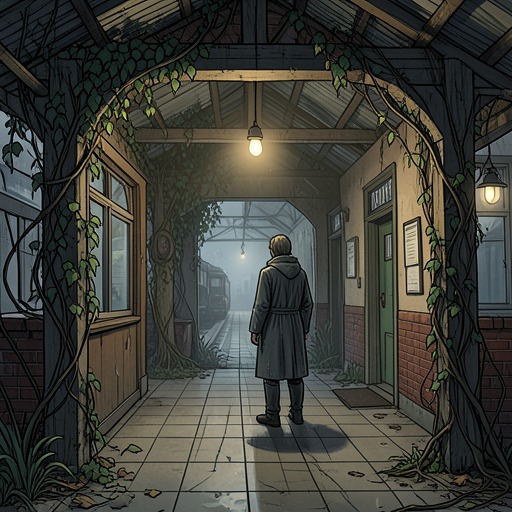
The city at night alters the mood of the journey. Henry is captivated by its many lights, which call the galaxy to mind for him. Grace’s destination is not a public attraction but a concealed remnant of the city’s past: behind a fence, she says, stands its last steam-train station, closed to the public for decades after the subway displaced the old line. The excursion moves from a familiar street, through an overgrown shortcut and a lit bus interior, into a hidden urban space whose history and isolation suit Grace’s way of seeing the world.
Trespass and the fishpond
At the station, an elaborate gate marks the transition from trespassing to breaking in. Grace passes through when the gate swings open at her touch, then leads Henry into the building. She uses her phone flashlight to guide them through empty, pitch-black rooms to a cast-iron spiral staircase descending into the basement. Above the stairs, a domed glass roof has a shattered panel through which a spray of stars is visible, a rare sight amid the city lights.
The pair cannot descend all the way because the basement is flooded. Grace sits near the bottom of the staircase, removes her shoes, and lowers her feet into the water. She breaks off a piece of bread and tosses it onto the surface. It vanishes with a small disturbance, revealing that fish are beneath them. Henry is startled, but follows her down, takes off his shoes, and sits beside her. Their clothes brush when either shifts position. As Grace feeds the fish, small silver bodies, each about the size of Henry’s palm, dart around their legs and brush their ankles. More bread brings more fish until the water around them seems alive with silver.
The scene slows the adventure into shared stillness. Grace hushes Henry when he reacts too loudly, and he falls quiet, watching both the fish and her. When the bread is gone, she leans back against the stairs with her arms behind her head; Henry mirrors her posture. His attraction is present, but the encounter does not resolve into a kiss or a declaration. Instead, closeness takes the form of sitting together in cold water, in a place Grace has chosen and knows well.
Injury, chance, and Grace’s reason for returning
Their conversation turns to personal questions and Henry’s interest in Grace. She objects to being treated as though physical details offer the most important knowledge about her, then gives a blunt account of the car accident she had survived about three months earlier. The car flipped seven times. She spent roughly a month in hospital, underwent treatment involving pins and skin grafts in her leg, and was mostly unconscious for a week. During another week she wanted to die to end the pain. She later had to learn to walk again and was left with extensive scars, which she refuses to show Henry. Her disclosure places the cane, limp, and difficult terrain of the walk within the concrete history of a severe injury and recovery.
Grace rejects the consoling idea that everything happens for a reason. Looking at the stars, she describes the universe as the product of physical processes and chance: beautiful, but not magical. Henry’s response remains partly comic and partly awed, but Grace’s account of the station adds personal history to her cosmic outlook. A friend brought her there when they were children; the two used to break in and talk for hours. She now comes back when she wants to be reminded of her insignificance on a universal scale. Space, she says, is the best cure for sadness she knows. The station is therefore more than a clandestine attraction: it is a place where childhood companionship, present grief, and the vastness of the universe meet.
The friend is later identified as Dom. In the account Grace gives Henry after he finds her at the station again, she recalls meeting Dom at nine, when her father was dead, her mother had been absent for days, and she had little food at home. Dom’s patience and welcome made the first day she spent with his family one of the best days of her childhood. This later knowledge deepens the earlier reference to a friend without changing the scene’s immediate terms: during the first visit, Grace speaks of the place and its companion in the past, but does not yet tell Henry the full story of Dom.
Farewell and the station’s return
As the first visit ends, Grace climbs the stairs and tells Henry she is glad they met. He returns the sentiment, then remains alone in the darkness as the light from her phone recedes until she is out of sight. The brief farewell gives their growing attachment a clear emotional beat, while preserving the distance between them: Henry has been admitted to one of Grace’s chosen places, but not yet to the whole history it contains.
The station returns later as the location Henry remembers when Grace has disappeared. He recognizes the fishpond as the place where she might be, drives into the city, climbs the fence, injures his ankle coming off a hedge, picks the lock, and hurries down the spiral staircase. He finds Grace alive, standing waist-deep in the still water. The discovery turns the earlier secret route into a desperate search, and the fishpond’s quiet wonder is replaced by the immediate relief of finding her.
In the water, Grace tells Henry more about Dom and about the anger beneath her grief. She takes a small metal box containing keepsakes from Dom’s shrine, including the anchor necklace she wore when Henry first saw her, a Strokes keychain, and Dom’s unwashed Ramones shirt. She leads Henry into the pond and releases the objects one by one, then lets the box marked DOM GRADE 10 sink among the fish. This later act does not make the first visit a simple foreshadowing of recovery: the station holds both the memory of a shared, tentative intimacy and the painful work Grace eventually undertakes there. Its fishpond gathers the event’s central contrasts—darkness and starlight, injury and movement, private memory and shared presence—without promising a finished or uncomplicated ending.